Friday, May 6, 2011

Grandson Update!

Little Sebastian is now six months old and has rapidly become the center of our universe. We are constantly amazed and entertained as he scans his new world for "input." He notices everything and flaps his little arms in an attempt to get at whatever he sees. Of course, Grandma and Grandpa assume he's a genius.

He's also a happy little guy, bestowing wide, toothless grins on one and all (though not necessarily on cameras).

These two photos and the one above were taken when he was three months old:


With Mom and Dad ...


It's been my privilege to babysit him a couple of days a week since his mom went back to work several months ago. Although he hasn't mentioned it, I feel we have a strong bond. :) At least he seems to enjoy pulling my beard. There's nothing quite like seeing him break into a broad grin when he sees me on waking up from a nap. He really seems to enjoy the guitar. When I play it he reaches out for the strings, generally grabbing on to them, but sometimes stroking them and eliciting an actual chord, and out comes the toothless grin.

Two wild and crazy guys ...


Four generations, with Tracey's mom, Betty ...


Easter, Sebastian style ...


Sunday, January 16, 2011

2010 Wrap Up

In 2010, GoJoe the RV found itself all over the map once again. There were roadbound adventures from Maryland's Eastern Shore to the tip of the Florida Keys to Southern California to the Rocky Mountains of Colorado and Wyoming. Also, as a family we traveled to the Maine Coast for a wedding. GoJoe stayed home for that one. To end up the year, we had the best adventure of all. We welcomed our first grandchild on October 5. Little Sebastian is the son of our son, Eric, and his wife, Malina. He's three months old now and is the apple of everyone's eye on both sides of the family. He's very alert and constantly scans his surroundings, soaking up "input" from his new world. He's also a very happy little guy, bestowing wide, toothless grins on everyone in his field of vision. Here are some scenes of the year's travels.

Our yard just prior to leaving for Florida in February ...


Hunting Island State Park, St. Helena, SC ...


Blue Springs State Park, Orange City, FL ...


Key West, FL ...


Bahia Honda State Park, FL ...


Sombrero Beach, Marathon, FL ...


Key Largo, FL ...


Tomoka State Park, Ormond Beach, FL...


Cherry Blossoms, Washington, DC ...


Hillwood Estate, Washington, DC ...


Grotto of Lourdes, Emmitsburg, MD ...


LL Bean Headquarters, Freeport, ME ...


Scarborough, Maine ...


Cape Elizabeth, Maine ...


Friday, October 15, 2010

Home!


The Trek Across America 2010 was fantastic, but it's also great to be home. I've actually been back for several weeks. I was moving so fast at the end of the trip that I outran the blog and had to make the last several posts from home.

A few observations: I again enjoyed travelling across the country and seeing the varied landscapes and meeting people along the way. There's nothing quite like being in some incredible natural settings in your own mobile house. On the other hand, this trip moved a little too quickly. First of all, I had a deadline to meet in California at the Lazy Daze RV headquarters. This meant that I couldn't linger in any one place too long. I actually didn't spend more than one night in any one place until I had left California and was all the way up in Wyoming. I was moving several hundred miles each day - way too fast. And then, once I'd had the work done on the RV in California, I wanted to make sure I got back home before the birth of our first grandchild. (Mission accomplished there.)

Also, this was quite a hot summer. One reason I travelled across the north is that I thought it would be cooler there. Think again. It was hot pretty much everywhere I went except for up in the Rockies. In Michigan and Wisconsin (and most everywhere else) it was in the high 90s and very humid, and in southern California it was 107 on the day of my visit to the Lazy Daze factory. I skedaddled out of there as fast as I could. Thank goodness for generators and AC!

And finally, this was the last long trip I'll take alone. There are some great rewards to be had travelling by yourself, deep in your own thoughts, making on-the-spot decisions without compromise. But the downside is that it gets lonely. I'm fortunate to have a wonderful mate who loves to travel and who brings the additional bonus of getting actively excited about things. While I enjoy things more or less internally, I've many times over the years had the pleasure doubled (and tripled) by experiencing something through Tracey's eyes and heart. She's like having a set of "feelers" through which things are sensed with excitement, joy and jubilation.

I would have loved to hang around at many of the places I visited and that's exactly what Tracey and I will do next year when we hit the road. We'd like to do what many RVers do -- take at least one "rest" day in between travel days. Better yet, find a place that we'd like to explore and put down temporary roots for maybe a week or so.

But I do want to say that none of the "downsides" mentioned above negate the fact that I loved every minute of moving along the highways, seeing spectacular things, hiking wilderness trails, meeting interesting people, and feeling the "in the now" serenity that comes with getting away from familiar surroundings, routines, and obligations. And I was able to see a great many places that exemplify things that are uniquely American, which was one of my goals. Also, I've done a lot of "reconnaissance" for our future travels. I feel like I've paved the way for adventures yet to come.

Now here's a great reason to be back home ...


Sebastian Heng Blanton arrived at 5:21 p.m. on October 5, 2010. He was a very healthy 7 lbs., 13 oz. and measured 21 inches in length. His mom Malina and his dad Eric are ecstatic to be his parents. Grandma and Grandpa are pretty much over the moon.

Sunday, October 3, 2010

Spammed!


Well, apparently there is a museum for everything. In Austin, Minnesota, I paid a visit to the Spam Museum, a tribute to the quintessential American mystery meat. It is housed at the world headquarters of Hormel Foods, which has been grinding up various porky parts and stuffing the result into blue cans since 1937.


While walking among the museum's exhibits, you learn that Hormel was founded back in 1891 when George Hormel opened a small butcher shop in Austin. But he had grand visions and the enterprise soon expanded beyond the small city in Minnesota, eventually becoming known worldwide. By 1937 George's son Jay was running things. It was Jay who came up with the canned meat concoction of ground pork shoulder mixed with ham and liberal dashes of salt and other spices. The word "Spam" (for "spiced ham") was the winning entry in a contest held to name the new product.

During World War II, cases of Spam were shipped by the thousands to U.S. troops in Europe and the Pacific. It was a popular item because the meat would stay fresh, or at least edible, without refrigeration. At times the soldiers ate it for breakfast, lunch and dinner. My dad remembered it as "Spam What Am."


Some of the Spam sent to the South Pacific made its way to the native islanders who evidently found it much to their liking. Today, Spam is a favored food in that part of the world. In Hawaii, it's considered a delicacy. Hormel has made versions of Spam available there that can't be found elsewhere including Honey Spam, Spam with Bacon, and Hot and Spicy Spam.

Hormel has a long history of advertising and media sponsorship such as the early-40s "The Hormel Program," starring George Burns and Gracie Allen. Following the war, the company cemented Spam into the national psyche by sending "The Hormel Girls," a sixty-member all-female swing band, across the land singing and extolling Hormel products.


In 1970, a famed sketch on Britain's Monty Python show depicted a cafe where just about all the menu items featured Spam (Spam, eggs, bacon and Spam, for instance). A group of Vikings eating in the cafe would burst into song - "Spam, Spam, Spam, wonderful Spam" - in the midst of the other actors' dialog. You can see a video here. This apparently inspired pranksters during the budding years of the internet to disrupt online news groups by filling the screen with the word "Spam" repeatedly. Thus the word has taken on the meaning of anything - bulk email, for instance - that disrupts normal internet usage.

See what all you can learn in a museum? Alas, they weren't giving out free samples of Spam. They were selling it in the gift shop, but I passed up on the offer.

One more thing about Spam, as if this weren't already too much. There's a website for Spam haiku, the seventeen-syllable Japanese verse form. Some examples:

Tastes like ham, sorta
But clogs up my aorta
Pig rigor morta.

The grim sucking sound
Of the SPAM shucking its skin,
Its hard blue cocoon.

Spock scans the pink meat.
"It's life, Jim," he tells Kirk, "but...
not as we know it."

Tuesday, September 28, 2010

The Place the Music Died


On the night of February 3, 1959, three of the biggest pop stars of the day boarded a small plane after playing a concert in Clear Lake, Iowa. Their lives ended just minutes later when the plane went down in a cornfield shortly after takeoff. That moment was immortalized by Don McLean in his 1971 song "American Pie."

You can still hear the music of Buddy Holly, Ritchie Valens and the Big Bopper on the radio today, more than fifty years later. Buddy Holly in particular has had a profound influence on American popular music. He wrote and recorded numerous hit songs in his life, many of which continue to be recorded by artists to this day. He was twenty-two when he died.

I was already a big music fan when these guys rose to popularity in the late 50s and can easily go in my mind's eye back to the time when "That'll Be the Day," "Oh Boy," "Peggy Sue," "La Bamba," "Chantilly Lace" and others were coming from the radio as new hits. I can also remember the plane crash.

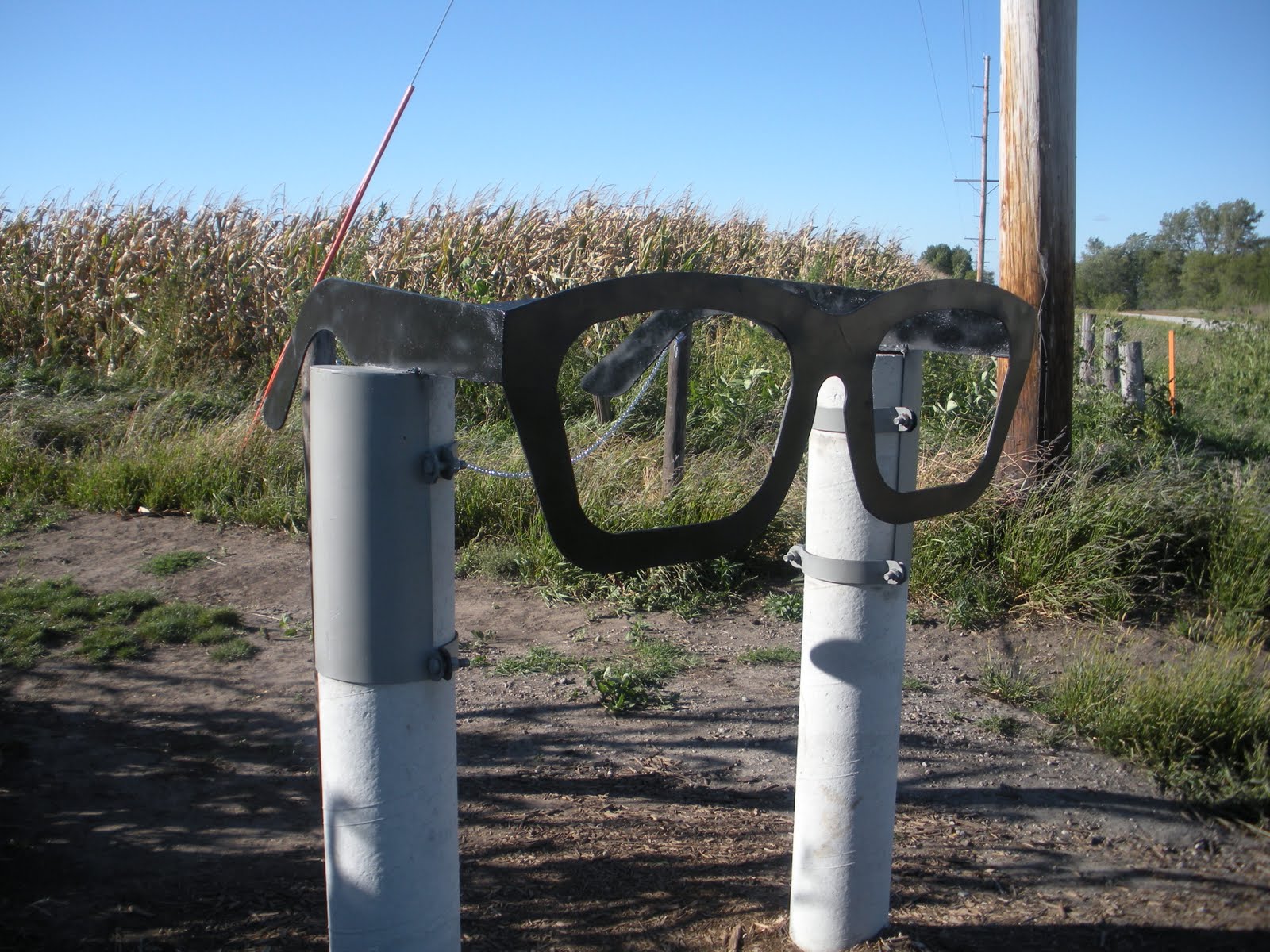
The site of the crash is in the middle of a cornfield and is marked by a simple metal memorial. There are no markers to guide you there or references to it along the highway. I found the directions on the Internet. After driving several miles down gravel farm roads, you come to a giant pair of glasses, a nod to Buddy Holly, who famously wore black rimmed spectacles.


At this point, you have to park and walk about a half mile along a path between rows of corn.


I was the only visitor at that particular time. It was while walking along this path that I had an "interesting" experience. In my mind I said something like, "Well, I'm here, Buddy." An instant later, I "heard" in my mind someone say, "You've already been there longer than I was." Hmmm.

When I reached the simple sign that marks the site, I stayed for a good while. It was absolutely quiet and there was definitely a special feeling about the place. Previous visitors had left dozens of glasses frames. There were also notes, guitar picks and other memorabilia scattered around the memorial.


The only other visitor while I was there was this bird who was so intent on munching a large bug of some kind that I was able to kneel down beside him and take his picture.


The bird was still there when I left. The next day I called a friend and mentioned that I'd been to the Buddy Holly crash site. He said, "Did you know that yesterday was Buddy Holly's birthday?" (He knew because his brother has the same birthday.) Yes, I felt a little chill.

Friday, September 24, 2010

Custer State Park, South Dakota


You come to Custer State Park in South Dakota's Black Hills to see the animals. And they come to see you! The fellow above, one of the park's "begging burros," was just hanging out in the road and when I slowly pulled up, he came right over. I think he wanted food, but signs warned against feeding the wildlife. "Pleeeze," he seemed to be saying ...


One of his younger relatives ...


Up the road a bit, a pronghorn antelope ambled across the road.


Bighorn sheep munch along the roadside.


The park is famous for its large herd of American Bison. Here they make an appearance at their evening dinner hour. On its way to its grassland feast, the herd moves across the roadway, blocking traffic. Unlike with city traffic jams, the motorists seem to enjoy it, as is evidenced by all the wide grins and clicking cameras.


Summer is molting season for the bison, and many of them looked fairly shaggy.

Mountain goats living it up at the State Game Lodge. I thought it was nice of the state to provide them with such upscale accommodations.


Custer State Park is also home to elk, mule deer, white tailed deer, mountain lions, and numerous species of birds. There are some beautiful scenic drives and hiking trails as well, which allow you to experience granite peaks, open prairie, pristine lakes and cool forests.

Thursday, September 23, 2010

Crazy Horse Memorial


During the 1930s, Native Americans in the upper midwest watched as the faces of four American presidents were carved on the summit of a mountain in South Dakota. Mount Rushmore sits in the middle of the Black Hills, a mountain range long held sacred by the Ogalala Lakota and other native tribes of the area. In 1946, Lakota Chief Henry Standing Bear asked noted sculptor Korczak Ziolkowski to create a mountain sculpture of Crazy Horse, a hero to the Lakota people, noting in a letter to the sculptor that "My fellow chiefs and I would like the white man to know that the red man has great heroes, too."

Ziolkowski, a man of tremendous tenacity as well as artistic skill, took on the challenge. He began working alone in 1948, slowly blasting away at the rocky outcropping on Thunderhead Mountain in the Black Hills just north of Custer, South Dakota. The rest of his life was devoted to carving the mountain.

Although Ziolkowski died in 1982, work continues to this day, overseen by his widow and seven of their ten children. The ongoing project has been self-supporting from the beginning, paid for by admission fees and private contributions. No government funding has ever been accepted.

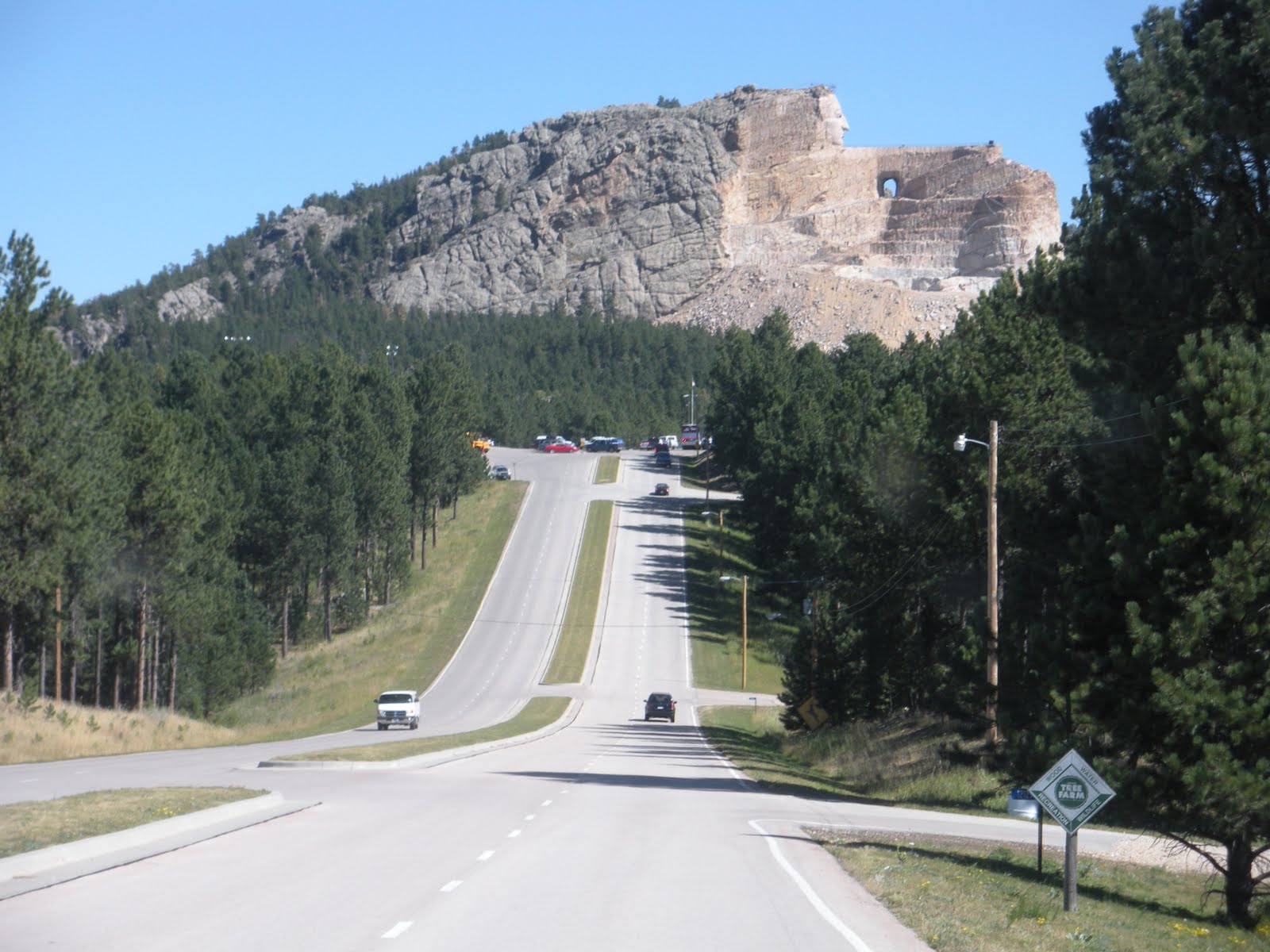
Tracey, Eric and I had visited Crazy Horse in 1994. Since that time, carvers have finished the face of the sculpture and I wanted to return to check out the progress. It's pretty impressive to make the turn from the highway onto the road leading to the mountain more than a mile away.


On one day each year, visitors are allowed to walk up the mountain onto Crazy Horse's "arm." Although I wasn't there on that day, I took a bus ride to the base of Thunderhead Mountain and was able to see the huge sculpture relatively "up close."


The "crown" on Crazy Horse's head is scaffolding that holds plumbs and other equipment that guide the blasting and carving.

When complete, the mountain will match the model shown in the foreground below. Crazy Horse is depicted pointing into the distance, a reference to a quote attributed to him: "My lands are where my dead lie buried."


The finished Crazy Horse Memorial will be 641 feet long and rise to 563 feet in height, making it the world's largest sculpture. Korszak's vision for the completed memorial includes a university and medical training center for the North American Indian and the Indian Museum of North America.

The project will take unknown years to complete, but the Ziolkowski family has no deadline. In an interview, Ruth Ziolkowski, Korszak's widow, said "Doesn't matter when it's finished. What matters is the work never stops and you stick with it until it's done."

Just as impressive as the vision of the Crazy Horse Memorial is the amazing and enduring commitment of this family to complete the Herculean task. They are already sixty-two years into the effort and show no signs of ever giving up. They are literally moving a mountain.

You can learn more about the Crazy Horse Memorial here.