Tuesday, August 17, 2010

Field of Dreams - Dyersville, Iowa

The movie "Field of Dreams" came out in 1989 and was an inspirational hit. In the story, the main character, played by Kevin Costner in the film, is directed by a mysterious voice to build a baseball field on his farm. "If you build it, they will come," he was told.

When making the movie, the producers looked for a farm with several qualities: It had to be surrounded by cornfields, it had to have period buildings, and it had to have a long lane leading from the road to the house. They found just the place at the Lansing farm outside of Dyersville, Iowa. Hollywood descended on Dyersville, the ballfield was built, and movie history was made.

After the filming, the Lansing family decided to keep the field maintained just as it looks in the movie. To this day, visitors can come to the ballfield. There is no admission charge. The site is humbly uncommercial and exquisitely kept. There is a small souvenier stand, but otherwise, it's just a beautiful farm with a baseball field, complete with bleachers and lights. Visitors can go out onto the field and play catch, hit a few balls, run the bases. Some folks like to film each other emerging from the high cornstalks as did the apparitions in the movie.

We came here as a family when Eric was eleven years old and playing Little League ball. We had a great time hitting and catching on the field. Since I was driving across Iowa, I just had to stop and see the field again.

More than twenty years later, they still come.


Saturday, August 14, 2010

A Tale of Two Houses

I went to southwestern Wisconsin to see two houses. Although the houses are only a few miles apart, they couldn't be more different. Not surprisingly, they are the products of strong and visionary individuals. I wonder if the two ever met.

THE HOUSE ON THE ROCK


This most unusual structure almost defies description. But in a nutshell, a young man from Madison, Wisconsin, set out, at first, to build a getaway home atop a glacial pinnacle. That was amazing in itself. Building materials had to be lugged by hand up the vertical stone shaft. But the ongoing construction never ended. By the time of his death in 1989, Alex Jordan had created a phantasmagorical world of soaring rooms, unbelievable views, indoor bridges, cave-like nooks, spiral staircases, streets (yes, streets), and veritable realms, all housing parts of his too-huge-and-varied-to-get-your-mind-around collections of musical instruments, works of art, historical artifacts, ships, guns, dolls, doll houses, sea creatures, airplanes, Zippo lighters, and on and on. (And on.) And throughout the "house" you encounter monstrously huge Rube Goldberg-like mechanical musical thingamabobs which employ, among other instruments, self-playing violins (each with four bows - one for each string), guitars, mandolins, pianos, trumpets, cymbals, tambourines, water jugs, or glass jars. You can only stand in amazement at the sight of these self-playing orchestras as they strum, bow, beat, or toot their way through the Blue Danube Waltz or the Dance of the Sugar Plum Fairies. At various points in the house you find yourself in the Ocean Room or the Doll Room or the Circus Room. Rooms in this context might be considered domed stadiums elsewhere. In one such room you encounter the world's largest carousel with its "269 hand crafted animals and 20,000 lights." Particularly exciting is walking out into the cantilevered Infinity Room, a slim prong extending 218 feet out into space, 156 feet above the valley floor.

I began the self-guided tour of House on the Rock with mild anticipation followed, in succession, by growing interest, admiration for Mr. Jordan and his many eclectic pursuits, appreciation for the amount of work represented, some curiosity about a point to all this, rising concern for Mr. Jordan, and slight apprehension at not seeing a convenient way to exit. I think I was into the third hour when total sensory overload set in. At that point, the experience began to take on aspects of a dream within a Tim Burton movie, especially so as the lighting was fairly dim throughout the labyrinthine structure.

Looking back in a nutshell: I LOVED this place and would go back in an instant.


And now for the next house ...

TALIESIN


This is the home and workplace of famed architect Frank Lloyd Wright. He spent his summers here and the winters at Taliesin West in Arizona. Wright is known for his simplified and organic designs in both commercial buildings and private homes. He tinkered with his ideas at Taliesin, which, like the House on the Rock, was a constant work in progress. By the way, Taliesin is pronounced "Tally Essen."

It's interesting to note that Wright, who died in 1959 and who worked almost up until the end, began practicing architecture in the mid 1880s, a time when frilly Victorian design was in full flourish. This was the world Wright was born into and, as an architect, was expected to uphold. In fact, his first designs were in the Victorian style. But early on he determined to be released from this mold. He envisioned buildings designed to fit into their surroundings, both in form and in materials used. He was obviously taken with geometric lines and shapes, as shown here in the house "Fallingwater." His designs are the essence of simplicity - long horizontal lines punctuated by strategic verticals and sometimes graceful curves. I found it interesting that he claimed to have been influenced by toy building blocks as a child.

I didn't actually get to visit Taliesin. It was late in the day when I got there (the House on the Rock ate up most of the day). Also, it was raining and a good portion of the Taliesin tour is outdoors. And finally, the price tag to get in is a bit hefty. I decided that this could wait for the day when Tracey and I can see the house together. I did, however, go on a short tour of the nearby Frank Lloyd Wright School of Architecture - which is housed in some of the earliest buildings Wright designed - and the Frank Lloyd Wright Visitors Center, which he also designed. These buildings all have the mark of the Wright influence.


Wright's emphasis on simplicity keeps coming back to me. There's a clarity of function about his buildings and it has great appeal.

I do wonder if Mr. Wright and Mr. Jordan ever met. Certainly their ideas on structure would be somewhat at odds. But maybe they would have recognized the genius in each other.

A word about southwestern Wisconsin. I had never been there and I had no idea how beautiful it is. I know they've had a lot of rain this year and maybe that's why it is so incredibly green. The emerald hills and valleys were a joy to drive through.

Friday, August 13, 2010

And Now I'm in Norway!

Hey, what's going on here? I was supposed to be off finding America. But my first night on the road was spent in Poland! (Ohio). And then I was in Holland, Michigan. Now, I'm in NORWAY! Well, actually it's "Little Norway" and it's in Blue Mounds, Wisconsin.

But wait a minute: that's what America is, isn't it? A patchwork of humanity from across the globe participating in this ongoing experiment called America. How cool is that! Obviously people from other lands came here, started communities, and named them for the places from whence they came.

Little Norway is a small slice of what life was like for Norwegian settlers in the upper midwest in the 1800s. This farm got its start back in 1856 when a farming family emigrated from Norway. For more than seventy years members of the family eked out a living on the farm, tilling the sloping Wisconsin fields. Most of the buildings at Little Norway date from that era. The original family of six shared a small cabin with one room downstairs - kitchen, living, and dining room - and one upstairs - the bedroom.

In 1927, the farm was purchased by Isak Dahle of Chicago as a retreat. It is presently owned and operated by the fourth generation of Dahle's family and is open to the public. The friendly staff is welcoming and eager to show visitors the farm buildings and explain the significance of the hundreds of farm and household artifacts and crafts.

A guided tour of Little Norway is an education in all things Norwegian. I have to admit that some of the more arcane aspects of Norwegiana were lost on me, but some of the people on our tour paid rapt attention to descriptions of weaving techniques, the meanings of the intricacies of certain painted designs, and the various functions of small, carved boxes.

I did perk up when our guide described how these large bowls, filled with ale, were offered to guests.

In my defense, the temperature was in the high 90s with the humidity in the same general range. I had thought I'd be leaving the hot weather behind in Maryland, but apparently it's everywhere this summer!


For me, the height of the tour was the impressive Norway Building. It was built in Norway for the 1893 Chicago Columbian Exposition and later moved to Little Norway.

It is patterned after a 12th century stavkirke or stave church, a medieval wooden church with post and beam construction.


I really did enjoy seeing the farm buildings and wandering the lush grounds of Little Norway, Wisconsin.


CAVE OF THE MOUNDS

As a sort of bonus, I got a free ticket to see the nearby Cave of the Mounds. Now, I should explain that I'm not really a cave kind of guy. For one thing, most of them haven't been eroding away for enough millions of years for me to stand up in them. I'm always grazing my head on the ceilings. Additionally, to me they are really just, let's face it, holes in the ground. Yes, they sometimes have interesting things hanging from the ceilings or lustrous colors on the walls. But you have to take a long walk in a low-ceilinged hole in the ground to see that. I usually spend my time in caves trying to remember the difference between a stalagmite and a stalactite in case the guide asks me. No guide has ever asked me this, but I keep thinking that they might.

I went into this cave for two reasons: it was free and it promised to be a lot cooler down there than up on top. On this last issue, it's interesting to see how long you can enjoy a drop in temperature from nearly one hundred degrees to just fifty. If you're dressed in shorts and T-shirt and you've been perspiring, it's not really that long. This realization arrives shortly after the tour begins.

Some of what was down there:


(OK, I can stand up in most caves, especially the ones called "caverns." It's just that somewhere along the way the passageways seem to close in and you have to "scroonch" through.)

Thursday, August 12, 2010

I'm in Holland!

Holland, Michigan, that is. I've known about Holland for a long time and have always wanted to see the town. It was founded by Dutch settlers and still retains it's Dutch roots. I kind of thought I'd see windmills and tulips and people with wooden shoes. Alas, not so. Yes, there is a tulip festival each year. Unfortunately, that was in the spring.

But what I did find in Holland is Hometown, USA. Living in a large metropolitan area, I sometimes long for the mythical small town seen in the movies -- a neat little burg with a thriving central area of businesses and shops and restaurants. Maybe with a nice leafy park right in the middle of everything. Well, Holland has all that.

This fellow, the Rev. Albertus C. Van Raalte and a band of merry Hollanders, founded this particular Holland on February 9, 1847. History records that the first few years were rather tough, but I'm sure they would be proud of the little town they left behind. It thrives just inland from Lake Michigan on the shores of its own Lake Macatawa.

It's a sort of Back to the Future kind of place, lost in time and yet somehow familiar.

Towns like this always get me to wondering what it would be like to live there.


Just picture yourself walking down this street ...


Or eating here ...


Or catching a movie here ...


Or stopping in to read here ...


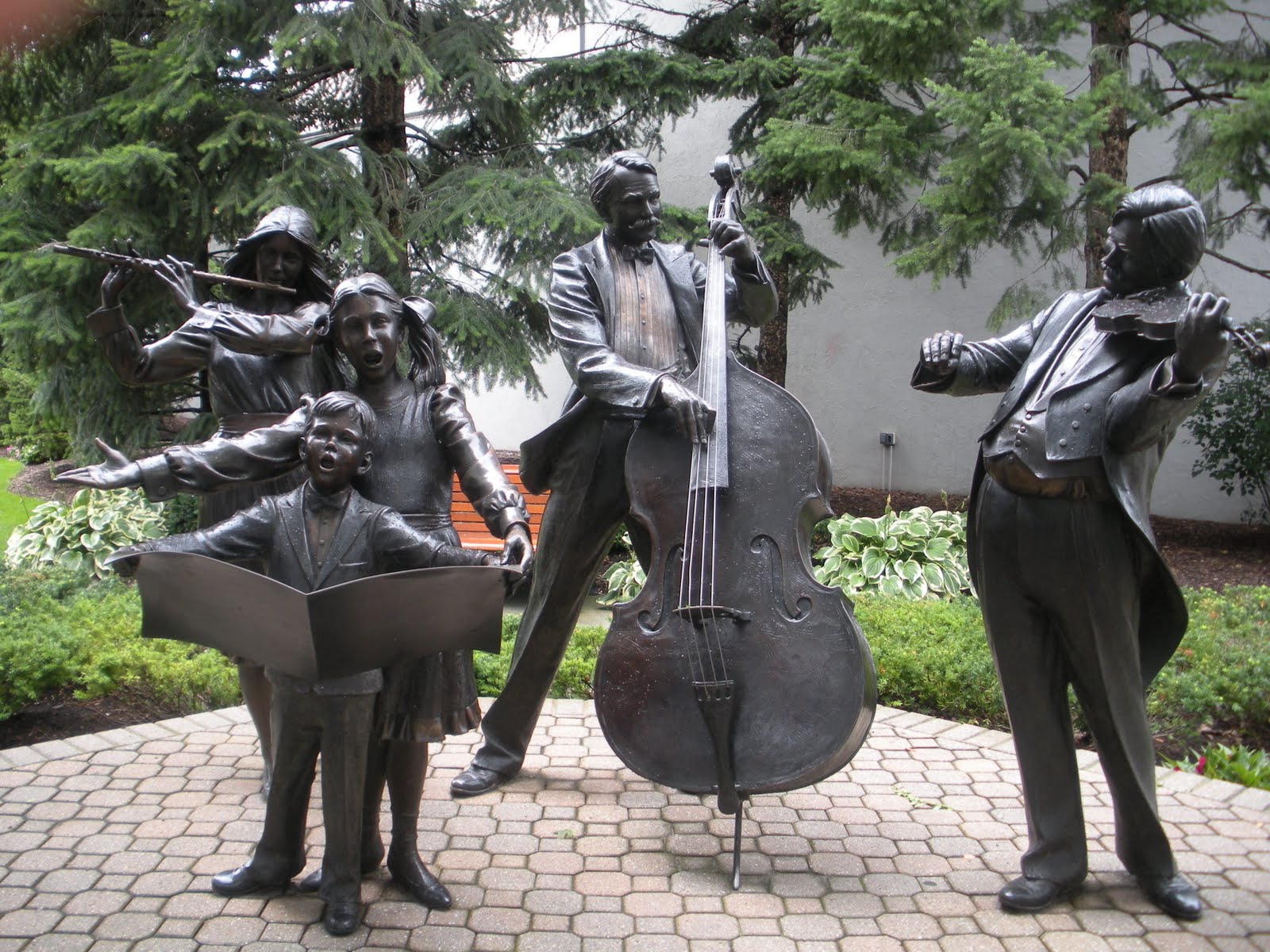
Or listening to these enthusiastic folks ...


Or contemplating the city park ...


Or living here ...


I know I did.

Even ol' Ben Franklin seems comfortable perusing the Declaration of Independence ...

Wednesday, August 11, 2010

Henry Ford Museum

I love cars. Always have. Especially the beautifully crafted motorized coaches of the 1930s and the swift rocket machines of the late 50s and early 60s. There was a time in my youth when my fondest desire was to go to Detroit and design automobiles. Spent most of that energy building Soap Box Derby racers.

Anyway, I've always wanted to visit the Henry Ford Museum in Dearborn, Michigan, just outside Detroit. The "Henry Ford" doesn't pay homage just to the automobile. It's vast holdings are a tribute to American creativity, industriousness, and vision of all types. You can see Thomas Edison's laboratory or Buckminster Fuller's "Dymaxion" house or the bus that Rosa Parks rode into history.

All these things are important and interesting, but I was there chiefly to see the cars. And boy do they have cars! To see everything at the Henry Ford would take days. The other exhibits and collections will have to wait for a future visit.

Henry Ford didn't invent the car. But he figured out how to mass produce them and get them into the hands of millions of people. His genius was the assembly line. At the museum you can see an "exploded" Model T and learn how it all came together on the line.

There are hundreds of automobiles on display. I was pleased to see that they weren't confined to just Ford models, although there are plenty of Fords. There are Chevies and other GM products, along with Chryslers, and long gone Packards, Hudsons, Nashes, Cords, and on and on. And that's just the American cars. There are plenty of rides from other countries as well.

A few examples:

A customized late 40s Mercury:

Classic '56 Chevy Bel Air with an early McDonald's sign:

Futuristic concept car:

First RV used by Charles Kuralt for "On the Road" ...


You can walk through these halls full of automobiles and see over a century of history unfold in boundless shapes of sheet metal. Running boards to tail fins to solar panels, it's all good. It's inspiring to see the inventiveness, engineering skill, artistry, and imagination that went into these machines. I can't wait to come back and see what else the Henry Ford has in store.